
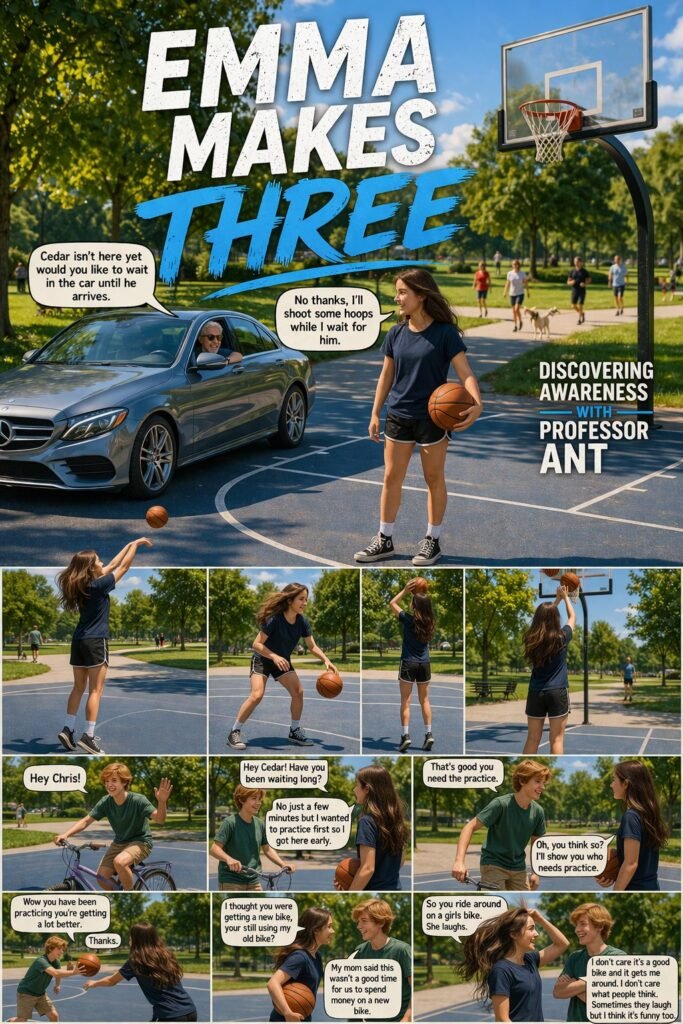
Professor ANT and Ron created a reading systems for slow readers. Our next book will debut this system. It’s called Image-Guided Comprehension Reading (IGCR)It is a dual-phase approach to reading. In the first phase, learners interpret a story through images, supported by text bubbles that introduce small, manageable amounts of written language within the visual context. This allows them to form a clear mental model of events, actions, and meaning while engaging with text in a low-pressure way.
In the second phase, they read the corresponding text-only version, using their prior understanding to guide decoding and confirm accuracy. Because comprehension is already established, learners read with greater clarity, remain more engaged, and experience less frustration. This process reduces guesswork, strengthens comprehension, and builds reading confidence—especially for those who struggle to connect words with meaning.
Below is a sample of an image page. The page following it would be text only. The text bubbles are repeated exactly in the text only side.
Understanding IGCR: Image Guided Comprehension Reading
Leave a Comment / Education / By Ron@discoveringawarness.com
Introduction to IGCR
Image Guided Comprehension Reading (IGCR) represents an innovative instructional strategy that integrates visual stimuli to facilitate the reading process. This method is designed to support learners in developing deeper comprehension skills by using images as tools for interpretation and understanding. IGCR is particularly significant in educational contexts where diverse learning styles prevail, allowing for a tailored approach to literacy instruction.
The essence of IGCR lies in its ability to enhance reading comprehension by inviting learners to engage with text in an interactive manner. By linking visual elements to written content, IGCR encourages readers to form connections between the text and imagery, promoting active engagement. This not only aids in decoding difficult texts but also fosters critical thinking and interpretation skills. Furthermore, the incorporation of visual aids can scaffold learning for students who might struggle with traditional reading methods, providing a platform for understanding complex narratives or concepts.
Engagement is another core advantage of IGCR. In a diverse classroom setting, students exhibit varying degrees of motivation and interest in reading activities. By integrating images, educators can capture learners’ attention, making the reading experience more enjoyable and relatable. This can be particularly beneficial in differentiated instructional settings where the needs of students vary widely. Visual stimuli serve as a universal language, breaking down barriers and thus enabling all students to participate fully in comprehension activities.
In summary, IGCR stands as a transformative approach in literacy education, promoting enhanced reading comprehension through the strategic use of images. This method not only facilitates understanding but also actively engages students, fostering a more inclusive environment for learning.
The Mechanism of IGCR
The Image Guided Comprehension Reading (IGCR) approach is an innovative methodology that leverages cognitive science principles to bolster text comprehension through the integration of visual aids. The fundamental premise of IGCR is that images, when strategically paired with textual content, can significantly enhance the reader’s understanding and retention of information. This mechanism operates on the interaction between cognitive processes and sensory inputs, which together facilitate better comprehension outcomes.
At the core of IGCR lies the dual coding theory, which posits that information processed in both verbal (textual) and visual formats is more likely to be remembered than information represented in either format alone. When learners engage with both textual and visual components, they create multiple pathways in their brains for information retrieval. This enhances the encoding process, making it easier for individuals to store and later access knowledge.
Moreover, visual aids can serve as powerful tools for clarifying complex ideas presented in text. For instance, when a diagram accompanies a written explanation, it can help bridge gaps in understanding by providing concrete representations of abstract concepts. Techniques such as infographics, annotated illustrations, and concept maps can be employed to facilitate this process. By presenting information in a visually appealing manner, IGCR minimizes cognitive overload, allowing learners to focus on grasping key concepts instead of deciphering overly dense text.
As a result, IGCR not only supports immediate understanding but also boosts long-term memory retention. The strategic use of images leads to enhanced engagement levels, which can, in turn, improve academic performance. Incorporating IGCR strategies within educational materials presents a robust method for fostering deeper comprehension across diverse learning contexts.
Applications of IGCR in Education
Image Guided Comprehension Reading (IGCR) has emerged as an innovative approach in educational settings, particularly in addressing the needs of diverse learners. Its primary objective is to enhance comprehension and engagement through the integration of visual elements in the reading process. This method has been effectively utilized in various classroom environments, showcasing its versatility and effectiveness across different learning profiles.
One significant application of IGCR is in the support of students with learning disabilities. These learners often face challenges in traditional reading and comprehension tasks, making it difficult for them to grasp complex texts. By incorporating images alongside textual content, IGCR allows for the simplification of information, providing visual cues that can enhance understanding. For example, educators have reported that students with dyslexia have shown remarkable improvements in their ability to interpret and engage with reading materials when IGCR strategies are applied. The addition of relevant imagery aids in creating connections between concepts, thereby fostering a deeper understanding of the material.
Moreover, IGCR proves beneficial for students facing language barriers, as it often delivers content in a more accessible format. In classrooms where English is not the primary language, images can serve as universal symbols that bridge gaps in communication. Teachers have noted that when visual elements are incorporated into lessons, non-native speakers are more likely to participate actively and demonstrate higher engagement levels, leading to improved academic outcomes. Case studies indicate that students exposed to IGCR techniques exhibited significant gains in vocabulary comprehension and usage as a direct result of this instructional approach.
Overall, the applications of IGCR in education highlight its potential to create inclusive learning environments that cater to the varied needs of students. By leveraging images in conjunction with text, educators can foster enhanced comprehension and engagement, ultimately contributing to students’ overall academic success.
Challenges and Future of IGCR
The implementation of Image Guided Comprehension Reading (IGCR) within educational settings presents several challenges that must be addressed to fully capitalize on its potential benefits. One primary barrier is resource availability. Many educational institutions may lack the necessary funding or access to modern technology that supports IGCR, which requires specialized software and high-quality visual materials. Without these resources, educators may find it challenging to incorporate IGCR effectively into their curriculum.
Another significant challenge lies in training educators to utilize IGCR methods proficiently. Professional development is vital to ensure that teachers are equipped with the knowledge and skills needed to implement IGCR strategies in their classrooms. This training must not only cover the theoretical aspects of IGCR but also provide practical, hands-on experience with the tools and techniques involved. Additionally, ongoing support and training updates are essential as technology and methodologies evolve.
Ensuring quality in visual materials is also a critical concern. The effectiveness of IGCR relies heavily on the use of high-quality, relevant images that align well with the reading material. Educational publishers and content creators must prioritize developing effective visual aids that enhance comprehension, rather than detract from it. Furthermore, the integration of user-generated content can help in making IGCR more adaptable and diverse, but it also raises questions about the quality and appropriateness of such materials.
Looking towards the future, advancements in technology hold the promise of enhancing IGCR’s effectiveness and reach. The rise of artificial intelligence and machine learning can enable personalized learning experiences, allowing students to engage with materials tailored to their individual needs and comprehension levels. Moreover, augmented and virtual reality technologies could provide immersive learning experiences, further bridging the gap between visual aids and textual comprehension.
This is the first story in the Discovering Awareness with Professor ANT series. Our other books are guided discovery but “Emma Makes Three” is the first children’s story. It’s about dealing with change you have no control over. Cedar, it’s his parent’s divorce. Emma, it’s a new school. Having to make new friends and leave old ones. For Chris it’s learning to live life in a wheelchair after being an athlete her entire life. It should be released by Summer.
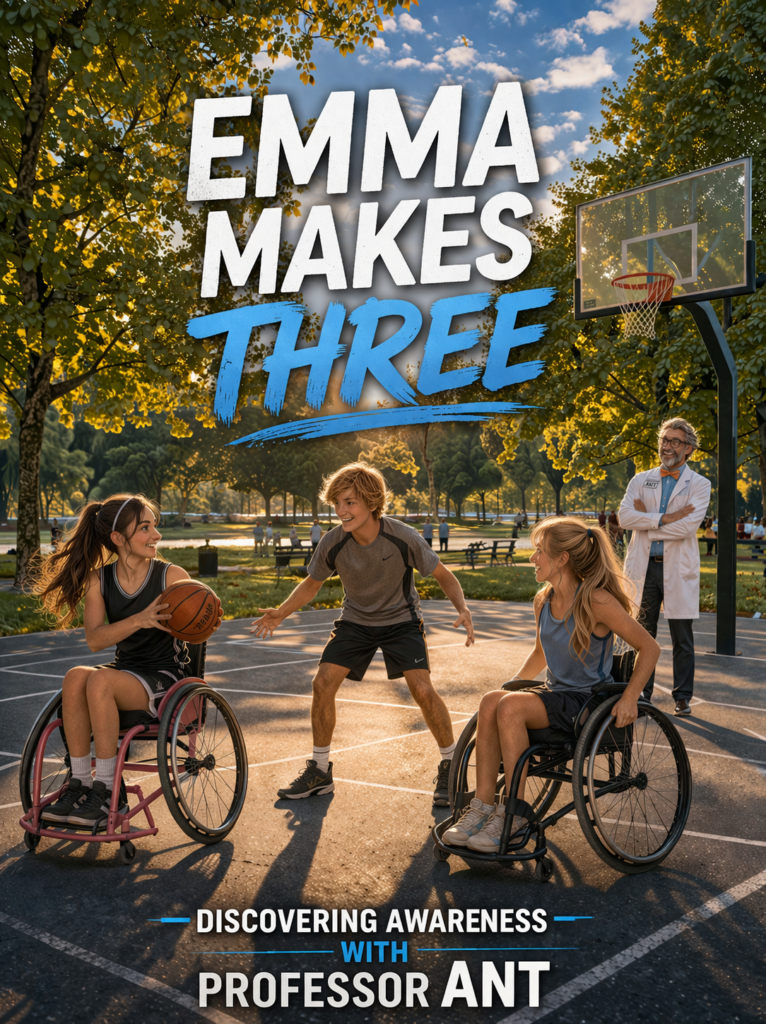
Image-Guided Comprehension Reading (IGCR)
Pilot Proposal for Early and Struggling Readers
Across classrooms, we consistently see students who can read words accurately but cannot explain what they’ve read.
This is not a decoding issue.
It is a comprehension sequencing problem.
Traditional instruction asks students to decode first and construct meaning afterward. For many learners, this results in guessing, disengagement, and declining confidence.
IGCR reverses that sequence.
How IGCR Works
Phase 1: Visual Comprehension (Comic-Style Learning)
Students experience the story visually—much like a comic book—where images carry the narrative and text bubbles introduce small, manageable portions of written language.
At this stage:
- Students clearly understand what is happening
- They follow sequence and cause-and-effect
- They connect words to meaning without overload
They are not trying to figure out the story.
They already understand it.
Phase 2: Text-Based Reading (Milestone Recognition)
Students then read the same story in a text-only format.
As they read and encounter the exact phrases previously seen in the text bubbles, each one becomes a recognition milestone:
- “I know this part.”
- “I got that right.”
Each of these moments acts as a small cognitive reward, reinforcing accuracy and motivating continued reading.
This creates a natural feedback loop:
read → recognize → confirm → continue
If meaning breaks down, students can immediately reference the visual page, self-correct, and move forward without frustration.
Why This Works
IGCR eliminates the most common failure point in reading instruction:
👉 Asking students to decode text they do not yet understand
Instead, IGCR ensures:
- comprehension comes first
- decoding becomes confirmation
- reading becomes a sequence of successful recognitions rather than guesswork
This reduces cognitive load, increases engagement, and builds confidence through repeated, successful validation.
Expected Outcomes
- Increased reading fluency
- Improved comprehension accuracy
- Reduced guessing behaviors
- Higher student engagement
- Increased reading confidence, especially among struggling readers
IGCR is particularly effective for:
- students who “read but don’t understand”
- early readers developing comprehension skills
- intervention groups needing structured support
Pilot Implementation
Target Group:
K–3 students and identified struggling readers
Structure:
- 10–15 minutes per session
- 3–5 sessions per week
- Integrated into existing literacy blocks or intervention time
Materials:
- IGCR-formatted books (visual + text pairing)
- No additional technology required
Evaluation Metrics
Progress can be measured through:
- Pre- and post-reading comprehension assessments
- Reduction in error-based guessing during reading
- Fluency tracking (accuracy and pace)
- Student engagement and participation observations
Summary
IGCR aligns reading instruction with how comprehension actually develops:
Students understand first—then read with confidence.
By turning reading into a sequence of recognized successes, IGCR replaces frustration with progress and uncertainty with clarity.